Texture
Dry, straw-like hair after children is a follicle problem, not a conditioner problem

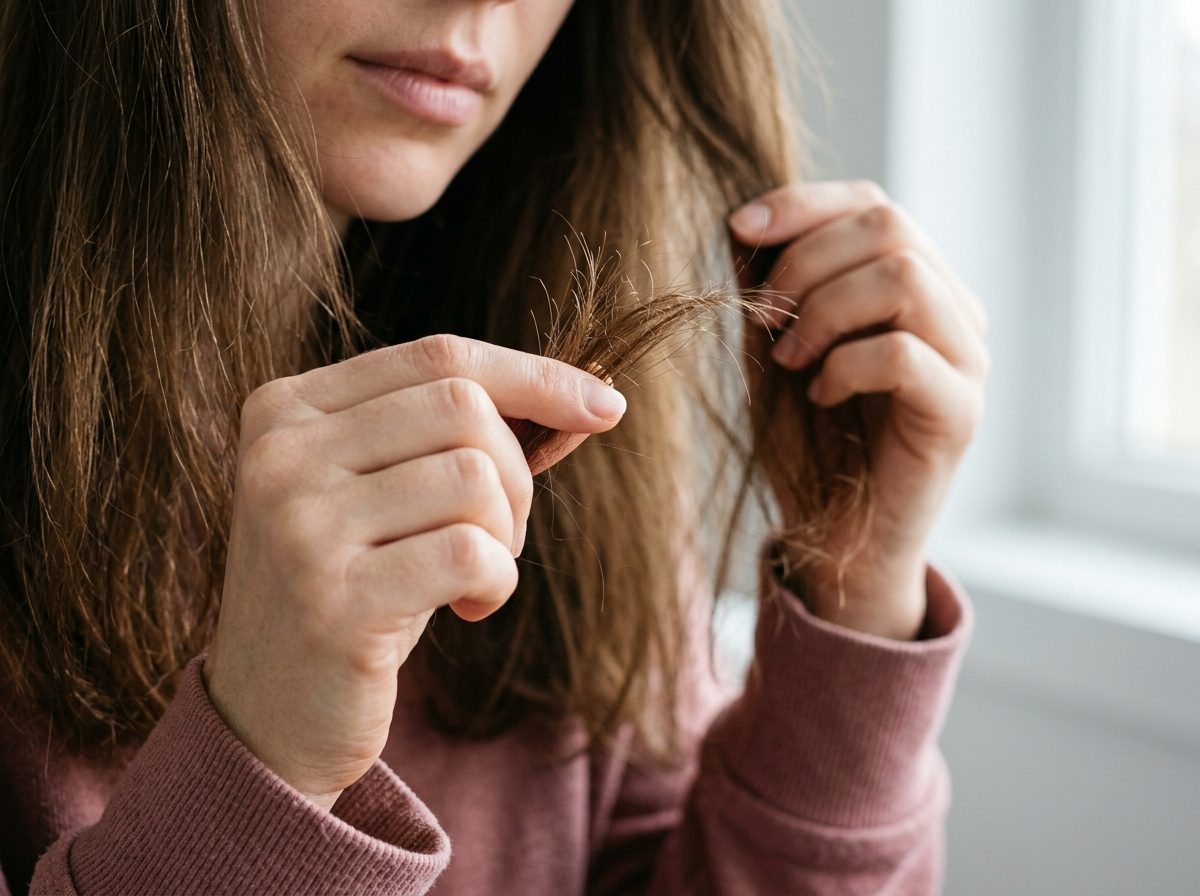
It is one of the changes women are least likely to mention in clinic, because it does not sound like hair loss. The hair has gone dry. Coarse in places, fine in others, frizzy at the ends, straw-like whatever conditioner or mask goes on it. It used to shine. It used to hold a blow-dry.
Where texture comes from
The quality of a hair is decided in the follicle, not in the bathroom. A healthy follicle in a long growth phase produces a fibre with a thick cortex, a tightly sealed cuticle, and a supply of sebum from the gland beside it that keeps the whole length conditioned. Every one of those depends on the follicle being well supplied and well signalled.
What changes after children
As oestrogen falls and the follicle miniaturises, it produces a fibre that is thinner, shorter-lived, and structurally poorer: a smaller cortex, a cuticle that does not lie flat, less natural oil reaching it. That fibre feels dry because it is dry, and no amount of conditioner applied to the outside will change what the follicle built on the inside. Straw-like hair after children is thinning that you feel before you can see it.
The conditioner is treating the symptom at the wrong end of the hair.
The tell-tale pattern
Texture change from the follicle usually comes with company: a ponytail that has got thinner, hair that will not hold a style, growth that seems to have stalled, more in the brush. Texture change from damage — heat, bleach, hard water — tends to be worst at the ends and improve toward the roots. If your roots are as dry as your ends, the problem is upstream.
Not sure which one is you?
Take the two-minute hair quiz
Twelve quick questions. We tell you what we think is going on, what to do about it, and we say so if it is something we cannot help with.
Start the quiz →What helps
Treating the fibre is fine and worth doing — a good mask makes the hair you already have more pleasant to live with. But the fibre that grows over the next twelve weeks is decided at the follicle now. Improving supply and restoring growth signalling at the scalp changes what the follicle builds, and the new growth comes in with a better cortex and a better cuticle. That is why, in clinic, texture is usually the first thing women report improving: it shows in the new growth at the roots weeks before density does.
Ready to read your own pattern?
Take the two-minute hair quiz
Twelve questions. We tell you what we think is going on for you, and we say so if it is something a GP should see first.
Start the quiz →