Reading the signs
Receding corners: is it the ponytail or the hormones?

The corners of the hairline are where mums notice thinning first, and the two most common causes are a decade of the same ponytail and the hormonal shift after children. Confusingly, most mums have some of both. The good news is that they leave different fingerprints.
Traction: what it looks like
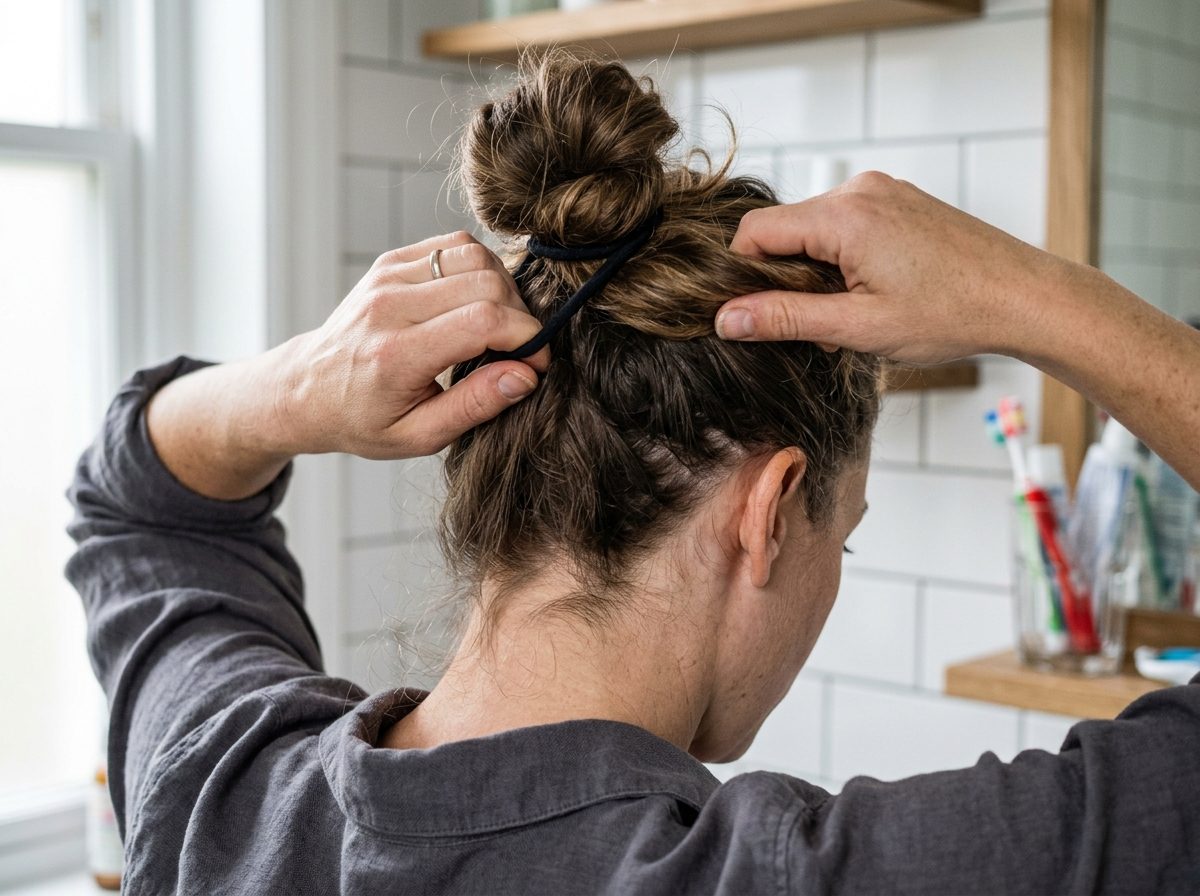
Traction thinning follows the style. It is worst wherever the pull is greatest — the very front corners under a high ponytail, a band along the hairline under a tight bun, sometimes a strip at the nape where the bobble sits. It is usually symmetrical only if the style is; women who always part or pull to one side thin more on that side. Up close, the edge of the hairline has short broken hairs of random length with blunt ends, and sometimes small bumps or redness at the follicles from the strain. The skin at the hairline may look slightly pulled or shiny. Crucially, the hair further back — an inch behind the hairline — is normal thickness.
Hormonal: what it looks like
Androgen-driven thinning at the temples is usually symmetrical regardless of how you wear your hair, and it is not limited to the very edge. Look an inch back from the hairline: the hair there is finer than the hair at the crown, and the fine hairs are soft, tapered and of similar length — miniaturised regrowth, not breakage. The scalp is calm, with no bumps or redness. It often comes with a slightly widening parting and a ponytail that has lost circumference, and it typically dates from a pregnancy or the late thirties rather than from a hairstyle.
The two-minute test
1. Pinch a short hair at the corner and run it through your fingers. Blunt or split end: breakage, which points to traction. Soft tapering point: a fine regrowing hair, which points to miniaturisation. More on that here.
Not sure which one is you?
Take the two-minute hair quiz
Twelve quick questions. We tell you what we think is going on, what to do about it, and we say so if it is something we cannot help with.
Start the quiz →2. Compare the two sides. One side clearly worse, matching how you wear it: traction. Both sides the same: hormonal.
3. Check an inch back. Normal thickness behind a thin edge: traction. Fine hair extending back from the edge: hormonal.
4. Feel the hairline. Bumps, tenderness or redness: traction, and it is still active. Smooth and calm: hormonal.
What each one needs
Traction needs the tension removed, completely, for three to six months. Follicles that have been pulled but not scarred recover on their own once they are left alone. The styles article lists what to wear instead. If the pulling has gone on for many years, some follicles may have scarred and will not return, which is why it is worth stopping now rather than later.
Hormonal thinning at the temples will not improve because you change the ponytail, though changing it is still worth doing. Those follicles are miniaturising because of what they are sensitive to and the signals they are missing, and they need a follicle-level treatment that addresses that. The hairline article explains the mechanism.
Ready to read your own pattern?
Take the two-minute hair quiz
Twelve questions. We tell you what we think is going on for you, and we say so if it is something a GP should see first.
Start the quiz →