Habits
Toppers, extensions and fibres: the honest guide to covering thinning while you treat it

Treating the follicle takes months. Life does not pause for it. A great many of the women I see use some form of cover while their hair recovers, and I would rather they did it well than quietly did it badly. Here is what each option actually does.
Root touch-up sprays and powders
A tinted powder or spray applied to the scalp along the parting and at the temples. It darkens the skin to match the hair, so scalp reads as shadow. This is the best cover for a widening parting, full stop: cheap, instant, invisible if the shade is right, and it does nothing to the follicle. Choose a shade slightly darker than your hair. Wash it out every two days; do not build up layers on the scalp. Not for the crown if you cannot see to apply it evenly.
Hair fibres
Keratin fibres that cling electrostatically to existing hairs and make each one look thicker. Very effective on diffuse thinning where there are still hairs to cling to; less so on a bare temple. They come off on pillows and in rain, and they need a spray to lock them. They do not harm the follicle if they are washed out properly. Apply to dry hair, then a light hold spray.
Toppers
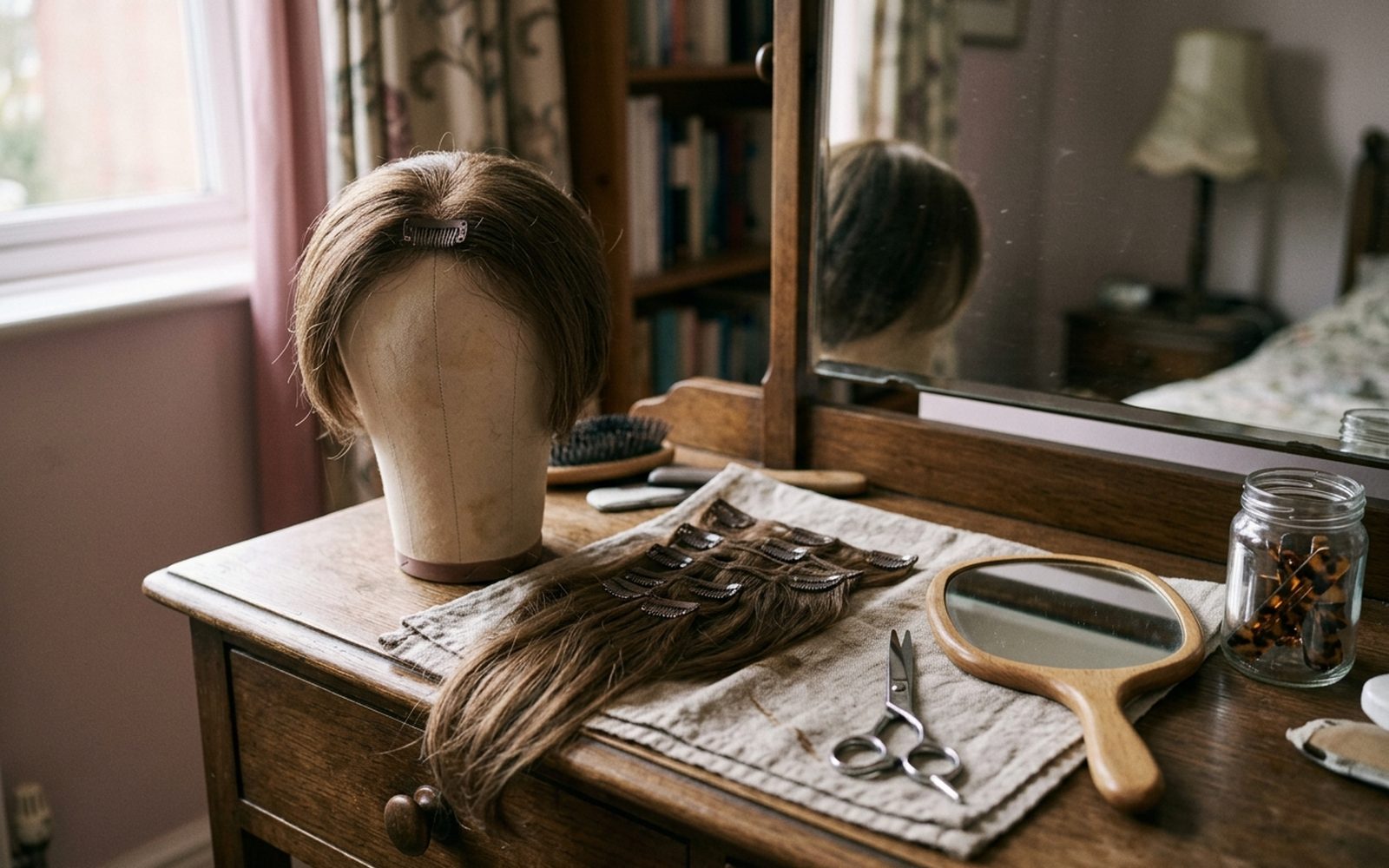
A small hairpiece — a few inches square to a full crown — that clips onto your own hair over the parting or crown. For moderate to significant thinning at the top, a good topper is transformative and nothing else comes close. Two cautions. First, the clips pull on the hair they attach to, and worn daily in the same place for years they cause traction loss exactly where you can least afford it. Move the clip positions, take it off at home, and consider a topper with silicone-lined or fewer clips. Second, human hair toppers need colour matching by a professional; a bad match is more noticeable than the thinning.
Not sure which one is you?
Take the two-minute hair quiz
Twelve quick questions. We tell you what we think is going on, what to do about it, and we say so if it is something we cannot help with.
Start the quiz →Extensions
This is where the harm lives. Extensions add length and volume to the lengths of the hair; they do nothing for a thin parting or temples, and every attachment method — bonds, tapes, rings, weaves — hangs weight from your own hair. On hair that is already fine or thinning, extensions are one of the more reliable ways to make it worse, because the weight pulls at the roots for weeks at a time and the follicles let go. I see the damage constantly: a band of broken, thinned hair at the level the rows sat. If you must, clip-ins worn for an evening and removed are the only kind that do not do this. Tapes on very fine hair, for months, are the worst.
Wigs
For significant loss, a modern lightweight wig or half-wig is a legitimate and often liberating choice, and the quality now is nothing like it was. Look for a breathable cap, take it off at home, and keep the scalp clean underneath. It has no effect on the follicle either way.
Scalp micropigmentation
Tattooed dots that mimic the shadow of hair follicles, usually on the parting or crown. It is semi-permanent, needs a skilled practitioner, and it commits you to a look; it is generally a choice for women whose thinning has stabilised rather than one to make in the middle of treatment.
The rules for all of them
Nothing that pulls on the hair, worn all day, every day. Nothing left on the scalp for more than two days without a proper wash. Nothing applied to a scalp that is sore, flaky or inflamed until it has been treated. And cover is not treatment: the follicle underneath is still doing what it was doing, and if it is miniaturising, the cover will need to get bigger every year. Use the months of cover to treat the reason you need it.
Ready to read your own pattern?
Take the two-minute hair quiz
Twelve questions. We tell you what we think is going on for you, and we say so if it is something a GP should see first.
Start the quiz →